Danielle Langley: A Bird’s Eye View of My Research Experience
In the middle of the hurricane-torn woods at Camp Fellowship, my professor and I stood, staring. The damages to the woods were quite extensive, much more than we had hoped. Giant trees laid on their sides with their roots completely ripped from the earth. Puddles of water had formed in the gaping holes left behind. We were worried about our research equipment, of course, but the wordless staring was more from the humbleness that followed the initial shock of seeing so many old trees, ripped up from the earth.
Following a few weeks after hurricane Helene tore through Greenwood, we had to go check on my acoustic sound recorders (or, ARUs) which were the main—and priciest—piece of equipment for my new research project. Starting out this research project in my junior year of college, I truly didn’t know much about it at that early point other than that it was, of course, going to involve the birdsong we were recording. This project was not only new for me, but new for my professor, Ms. McDonald, as well. We had set the ARUs out a couple of weeks before the hurricane, with the naïve thought we would check on them for the next few weekends.
As we hiked through, we came into a field that was oddly open for being in the middle of what used to be a dense forest. We looked up to see the bright blue sky where normally various shades of leaves would’ve obstructed this view. The hurricane had ripped apart much of this dense canopy cover, and the lack of shade was oddly disorienting. I remember specifically saying that I had no clue where we were, despite having been to Camp Fellowship a multitude of times before for various other projects and labs. The trails we normally followed were both obstructed and unrecognizable, we were lost.
At one point, while haphazardly forcing our way through the brush, we passed by a large tree still most of the way standing up, but split through the middle vertically. The wind had sliced through the tree, it seemed. I was so astonished by this that I paused and stared for a good few minutes before continuing to force my way through the woods. It was just such a strange sense of feeling so small while looking at all of the destruction that happened to the land, to nature, in contrast to what I’d seen in the rest of Greenwood. I had thought, at the time, that the feeling of pure shock was due solely to the damages. Looking back, I know I was also shocked at finding myself in the woods, looking for tiny machines that were part of a project I got to design and fulfill.
What was normally a quick 2-hour check of the 12 ARUs, became several hours before we even found the first 4. By the time we found the 9th ARU, I was exhausted. My legs burned with every step and I was incredibly frustrated every time we came upon another tree we’d had to either crawl over or shimmy under. Despite these frustrations though, I still regard this day with great amusement. All things considered, I had a good time. Sure, I was tired, so was my professor. But we definitely knew each other better by the time we left after the several hours spent in the woods completely lost. At the time, this was at the very beginning of my project and I was quite unaware of how valuable this particular experience was.
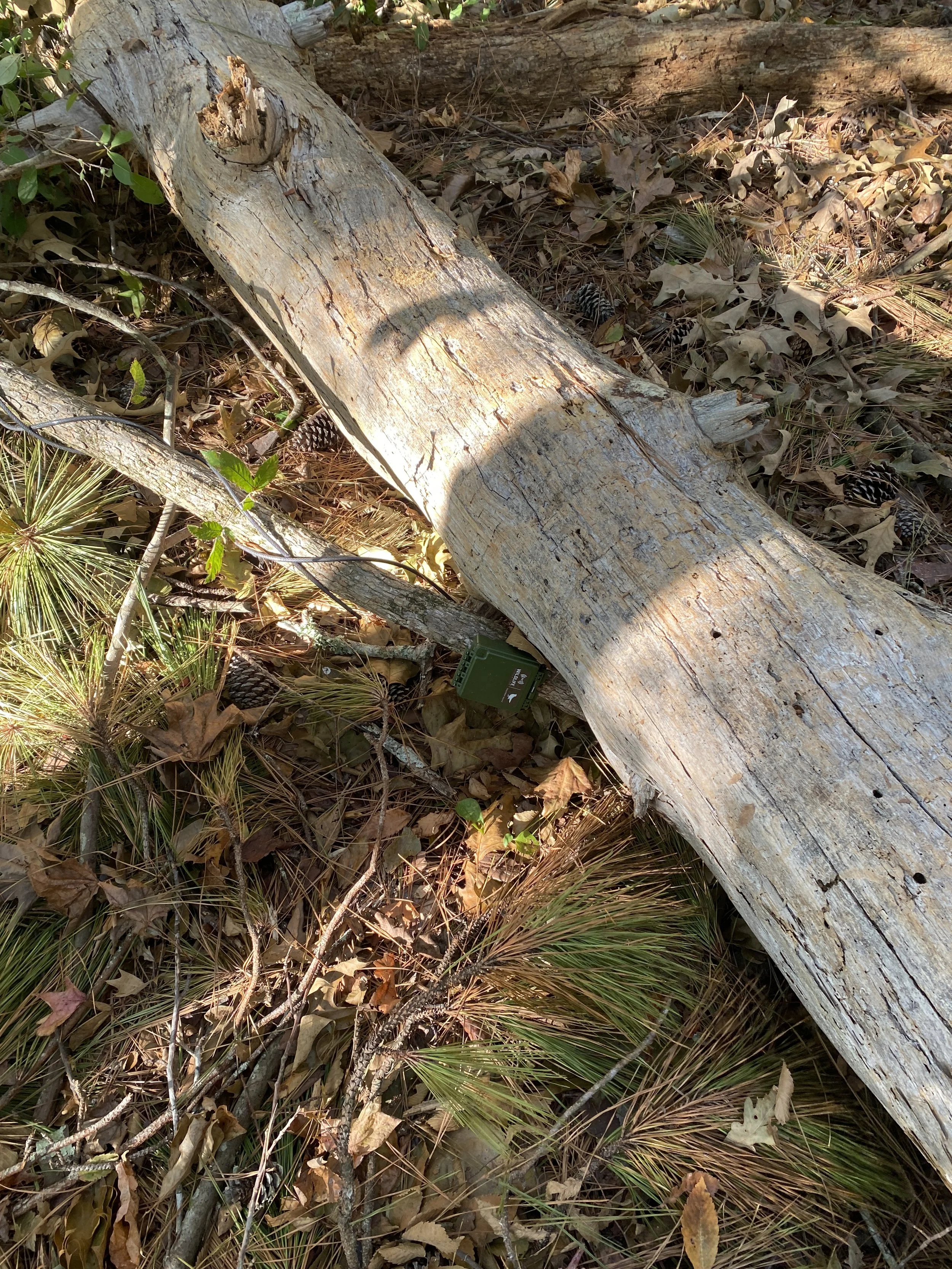
An ARU, inches away from being smashed by a fallen tree. Miraculously, all 12 ARUs survived hurricane Helene.
Truly, when deciding to be Biology major in college, I doubted I could do it. It definitely wasn’t a nice thing to think of myself before I even gave it a shot, but I was already convinced before classes even started that I was going to have to switch my major because I wasn’t going to be smart enough. Once I got through my freshman science courses, I started to cautiously believe maybe I could go another year. My doubts then switched to fixate on what I was going to do after college. During my junior year, I would tell myself that I could do biology in college, and I could do my research projects, but I wouldn’t be able to get into graduate programs or do well in the biology jobs that I was interested in (conservation, mainly). I was always really weirdly scared of the field work, surprisingly enough for someone who quite enjoys the outdoors.
Another reason I was hesitant to start research was the fear of losing my passion. Birds, just as general topic, have been such a huge and all-consuming interest of mine since I was in my early teens. It’s gotten to a point that I have a hard time remembering what I was like before I really started getting into birdwatching, bird researching, and bird art. What if research ruined my love for birds and this interest became a chore? This had often happened on smaller scales through high school, when I’d hate reading for class, or hate painting for art assignments.
Several months after the post-hurricane ARU check, I presented my research poster at the Association of Southeastern Biologists and I got to see just how many people were delighted to hear about my work with this new birdsong recording technology. In response, I genuinely was so excited to talk about my research and it didn’t feel nearly as nauseating as any class presentation. This was the one experience that truly made me believe, more than any good grade, that I could do this. The encouragement from my professors, my friends, my family, definitely helped me get rid of some of the haunting and everlasting imposter syndrome, but the thing that really gave me room to breathe was when I proved to myself that I could not only do this, but enjoy it. The intense introspection really came to a more or less conclusion when I realized I had experienced a lot of what I was so terrified of not being “good enough” to complete. I planned a research project, I put in weeks of (sometimes quite strenuous) field work, I presented this research to strangers at a biological conference, and through all of it, I was good enough. When I think back to the ARU check post-hurricane, I am amused. If I could still enjoy my research, and still love birds, while being tired, dirty, hungry, and frustrated, then I know I am going to be fine in whatever I choose to do post-graduating.
Danielle Langley is a biology major with minors in environmental science and English from Lexington, SC. She has given two research presentations at the Association of Southeastern Biologists conference and plans to present her research a third time in March 2026. Danielle plans to graduate in the spring of 2026 and attend graduate school to pursue a career in ornithology.